Thursday, March 19, 2020

The Clothes With No Emperor: Joe Biden On Policy

When it comes to policy, Joe Biden is an empty suit. This has been a persistent theme in the former Vice President's career, one on which this writer has frequently commented and one Sunday's Democratic presidential debate certainly reinforced, offering an extended and particularly concentrated look at Biden's complete lack of substance.


This is not to say Biden doesn't have a very long policy record. It's just that, throughout his career, his policy concerns have always been dictated by self-interest and, most especially, serving the needs of his big donors. In trying to explain that record, biographers of Biden's political career will struggle in vain to find any other through-line.

Biden has often voiced a disdain for policy. "When I marched in the civil rights movement," he told a New Hampshire audience in February 1987. "I did not march with a 12-point program. I marched with tens of thousands of others to change attitudes. And we changed attitudes." Actually, Biden never marched in the civil rights movement, not to enact policy, not to change attitudes, not for any reason. On another occasion, he got into an ugly exchange with a questioner and went on a rant against policy:
"[W]e have never, as a party, moved this nation by 14-point position papers and 9-point programs. It seems to me that when we got involved in the civil rights movement, Frank, nobody asked Martin Luther King what his legislative agenda was. He marched to change attitudes. When the women's movement started, it did not move with a constitutional amendment. They marched to change attitudes."
He went on to further denigrate policy and to suggest that what's needed instead is leadership, something that, in a political context, is impossible to detach from policy but something he, for his own purposes, presents as entirely divorced from it. The notion that these and every other such movement haven't had pretty extensive legislative agendas--not just as some side-feature but as basic demands driving them--is, of course, absurd and anti-historical but these and other such comments establish Biden's dismissive view of policy. When Biden entered the current campaign, he had no policies at all, presenting his run, instead, as part of "a battle for the soul of this nation."

It is, of course, impossible to run for president without any policy proposals--what else is a candidate to even talk about or run on?--so Biden eventually put his underlings to work creating proposals he could present as his own.[1] As I wrote in a recent editorial, Biden "offers for policy only a string of thin, half-baked and generally very bad ideas slapped together by his underlings that he may say he has something and that are clearly as much a mystery to him as to everyone else."[2] None of them are serious, and he isn't serious about any of them.[3]

Biden is an essentially conservative opportunist in a progressive party. He tries--badly--to fake all sorts of passion at times but there's no core to him; his entire political history is one of a conservative who walks away from retrograde views only if and only when they become politically risky within the Democratic party, and when he judges flip-flopping is safe. He has also been a leader on many issues but all of them--gutting bankruptcy protections for creditor on  behalf of the financial services industry, pimping the Iraq war, pushing "tough on crime" policies that obliterate civil liberties, etc.--are toxic to progressives. That's why his scorn for talk of policy; he's been all over the board on the policies that are important to Democratic voters and much of the policy he's pushed is really bad.

The sharp division between Biden's record and where the voters in his party are has led Biden to spend  much of his latest presidential campaign either repudiating most of what he has done in the course of his career or lying about it in an effort to make it seem more palatable. Sometimes both.[4]

Biden spent a lot of his career trying to out-"tough" Republicans on crime, leading to, among other things, the mass-incarceration epidemic that has plagued the U.S. for decades. He authored the 100-to-1 crack/powdered cocaine sentencing disparity that targeted the black community. Black voters are an important constituency for anyone pursuing the Democratic presidential nomination, so now, Biden says that policy was "a big mistake." And an example of systemic racism! In July, Biden released a criminal justice "plan." His suggested criminal justice policy? Reverse the "criminal justice" policies he's spent his entire political career supporting. For more than four decades, Biden has been been an unshakeable supporter of the Hyde Amendment, which bars federal funds from being used for abortions.[5] Then, in May, he suddenly announced he was opposed to it. A couple weeks later, he was suddenly for it again, insisting that his earlier comments in opposition to it were a result of his having misunderstood the question he'd been asked. Then, within 48 hours--after there was some pushback--he was opposed to it again.[6] Early in the campaign, Biden was trying to draw some of the progressive reform mojo from Sanders and opposed support for his campaign by super PACs. But October, the complete lack of enthusiasm for his campaign having caused his grassroots fundraising to collapse to virtual non-existence, he reversed course and accepted super PAC support, which was immediately forthcoming. For much of his career, Biden was an advocate for what is misleading labeled "free trade," policies that have stripped wide swathes of the American industrial base in the name of corporate profits. In the mid-'90s, he briefly switched to more populist rhetoric, talking about how the little guy was getting screwed by such agreements, but even during that brief period, he was always hit-or-miss on support for these policies. Once he became Obama's Vice President, it was right back to supporting "free trade" again and particularly the big, proposed pact of that era, the Trans Pacific Partnership. Then, in this campaign, after years of unbroken TPP promotion, he flipped again and said he wouldn't rejoin the TPP "as it was initially put forward"--the deal he'd praised and promoted.[7]

These habits were on display in spades during his Sunday debate with Bernie Sanders.

The day before that debate, Biden announced he suddenly supported bankruptcy reform legislation proposed by Massachusetts Sen. Elizabeth Warren. This was the latest in a long line of examples of Biden endorsing a policy that would entirely undo one of the major legislative accomplishments of his career, the Bankruptcy Abuse Prevention and Consumer Protection Act of 2005 (BAPCPA), a noxious law pushed by the financial services industry that put the screws to debtors. In a January article, Adam Levitin, a bankruptcy law professor at Georgetown Law who worked with the Warren campaign on its reform proposal, described the bankruptcy bill as "perhaps the most anti-middle class piece of legislation in the past century." He covered some of its provisions:
"Bankruptcy law offers debtors a choice between a Chapter 7 and a Chapter 13 process. In Chapter 7, debtors surrender their current assets above a minimum level to creditors, but retain all of their future income. In Chapter 13, debtors retain their assets, but are required to devote all of their disposable income for several years to a demanding payment plan. Chapter 7 gives debtors an immediate 'fresh start,' by wiping out most debts. Chapter 13 debtors have to repay more, and many ultimately fail to complete payment plans.

"As the Prospect detailed Tuesday, BAPCPA made it harder for consumers to file for Chapter 7 by imposing a 'means test' for Chapter 7 eligibility, and by substantially increasing the cost of filing for bankruptcy. This caused debtors’ average total out-of-pocket costs for filing for Chapter 7 to rise from $600 to $2,500. The subsequent result was a permanent 50 percent drop in Chapter 7 bankruptcy filings. BAPCPA made bankruptcy too expensive for the most broke households, making financial stress, mortgage defaults, and foreclosures more likely, particularly after the 2008 financial crisis."
During the Sunday debate, Biden was asked about the legislation and manufactured a complex but almost entirely false narrative about his involvement with it:
"Number one, let’s talk about the Bankruptcy Bill. The Bankruptcy Bill was passing overwhelmingly and I improved it. I had a choice. It was going to pass, and a Republican president, Republican Congress. I offered two amendments to make sure that people under $50,000 would not be affected, and women and children would go to the front of the line on alimony and support payments. That’s what I did. It passed overwhelmingly. I did not like the rest of the bill. But I improved it, number one.

"Number two, I’ve talked with Senator Warren about her proposal. This is the first opportunity we’ve had to make substantial change in what we couldn’t get done in a Republican administration. That's why we talked last... two nights ago, and I supported her proposal. It’s a good proposal, it’s a solid proposal. She should get credit for having introduced it."
Sanders retorted, "Joe, if my memory is correct, you helped write that bankruptcy bill."

"I did not," Biden flatly said. Then, he said it again. He reiterated, "It was going to pass anyway. I made it... Let me finish. I made incrementally better. I did not like the bill. I did not support the bill. And I made it clear to the industry, I didn't like the bill."

The facts: Biden, whose Senate career was bankrolled by the powerful financial services industry in his state, was one of the champions and prime drivers of the bankruptcy legislation. He was one of its earliest supporters and he worked for years to pass it. This wasn't, as Biden would now have it, a case of his reluctantly becoming involved when Republicans controlled the presidency and congress and just trying to make a bad but inevitable bill better; Biden's involvement started under Democratic President Bill Clinton, not Republican George Bush Jr.. Between 1998 and 2005, Biden showed his lack of support for the bill by voting for four different versions of it. That no doubt made it clear  to the industry that he didn't like it! FactCheck.org recounts:
"On March 15, 1999, Republican Sen. Chuck Grassley announced that he had introduced the Bankruptcy Reform Act of 1999 with the support of Democratic Sens. Robert Torricelli and Biden.

"'Sen. Chuck Grassley today introduced a bipartisan plan to improve the nation's bankruptcy system,' the Republican senator announced in a press release. 'Sens. Robert Torricelli of New Jersey and Joe Biden of Delaware joined Grassley as co-sponsors of the Bankruptcy Reform Act of 1999.'

"In 2000, Biden was a member of the House-Senate conference committee that resolved the differences between the chambers' bankruptcy bills before sending a final version to [President Bill] Clinton.

"On the Senate floor the day the bill passed on Dec. 7, 2000, Sen. Orrin Hatch singled out Biden, among others, for his work on the bill--crediting its passage to Biden's 'unwavering dedication to accomplishing the important reforms in this bill.'"
His current denials aside, Biden did help draft that conference version of the bill. Over Biden's objections, Bill Clinton pocket-vetoed it late in his presidency.

In 2000, Biden, the top Democrat on the Senate Foreign Relations committee, took a different tack; trying to pass it by slipping it into an unrelated bill. The New York Times recounted how Biden was deeply in the pocket of Delaware credit giant MBNA:

"MBNA has been the No. 1 donor to Senator Biden's campaigns since 1993... What did MBNA get for all that money? While Mr. Biden's main work has been on the Foreign Relations Committee, he has been a consistent advocate for MBNA. He has actively supported the company's favorite federal legislation, the Bankruptcy Reform Act, which would make it more difficult for consumers to escape their credit card debt.

"Senator Biden shepherded the bankruptcy legislation along by taking the unusual tack of inserting it into a foreign relations bill in 2000, said his spokesman, Norm Kurz."
FactCheck continues:
"...Grassley reintroduced the Bankruptcy Reform Act in July 2001 and Biden co-sponsored it. Biden was a member of an informal conference committee to work on the bankruptcy bill, and the committee was scheduled to have its first meeting on Sept. 12, 2001--which, as it turned out, was the day after the 9/11 terrorist attack. At the time, Congressional Quarterly described Biden as 'one of the measure's most vocal supporters.'

"It wasn’t until 2005 that the bankruptcy bill became law.

"As he did in 2000, Hatch praised Biden for his help on the bill on the day that the Senate passed the legislation. Hatch said Biden had worked 'tirelessly for years on this legislation, and they have taken some tough votes to get it done.'"
The debate over the bankruptcy bill in its various forms sparked a long public feud between Biden and then-Harvard law professor Elizabeth Warren. As Warren explained it,
"'I got in that fight because [families] just didn't have anyone and Joe Biden was on the side of the credit card companies,' Warren said after an April rally in Iowa. 'It's all a matter of public record.'"
This is, in fact, what led Warren to become involved in politics. Biden now praises Elizabeth Warren for her proposal to undo this, one of his own signature accomplishments, but in real time, he dismissed her as a demagogue.

Biden touts his support for a pair of amendments to aid low-income creditors and women getting child-support payments but the impression with which Biden tries to leave listeners is directly the opposite of what he actually did when working on the bill. In an article broadly detailing Biden's long history of serving the financial services industry, Mark Provost writes
"Usually, Biden opposed even modest protections for borrowers. For instance, he voted against one amendment that would protect mothers who failed to receive their child support or alimony. He voted against setting a limit of 30 percent on loan interest. He also voted against special protections for bankruptcy among former military, victims of identity theft and those with unmanageable medical debt."
Adam Levitin dove into Biden's many votes on proposed amendments to the bill:
"Biden... consistently voted against efforts to soften BAPCPA's blow on vulnerable populations. He voted against three amendments to ease bankruptcy requirements for consumers whose financial troubles stem from medical expenses. He voted against an amendment that would have helped seniors keep their homes. He voted against exempting servicemembers and widows of servicemembers killed in action from the law’s eligibility restrictions. He voted against an amendment to exempt women whose financial troubles stemmed from deadbeat husbands’ failure to pay child support or alimony. And Biden even voted against an amendment that would have ensured that children of debtors could still be given birthday and Christmas presents. Biden also voted against allowing debtors to pay their union dues during bankruptcy, potentially imperiling their employment and ability to achieve financial rehabilitation."
Then, there are the amendments Biden supported...
"It’s not as if Joe Biden was opposed to all amendments to the legislation: He voted to enshrine a 'millionaire’s loophole' that allows wealthy, well-counseled debtors to shield their assets from creditors by placing them in asset-protection trusts. Nor did he act to cut off the loophole that shields assets placed by wealthy families in 'dynasty trusts,' such as are offered by Delaware."
And even the amendments Biden now touts as supporting women and children:
"Biden claims that he worked to ensure that the legislation protected the interests of women and children by making the repayment of alimony and child support obligations the top priority in bankruptcy. This is false. Prior to BAPCPA, domestic support obligations were formally eighth in line for repayment. Functionally, however, they were second in line, right after the administrative costs of the bankruptcy, because the obligations ranked second through seventh priority, such as emergency bailout loans from the Federal Reserve or money owed to grain elevators, do not exist in consumer bankruptcy cases. The Biden bankruptcy bill rewrote the statute to provide that domestic-support obligations are to be paid first--unless there are administrative expenses. In other words, BAPCPA’s protections for women and children were all window dressing. Women and children still stand behind administrative expenses in bankruptcy. The claim that BAPCPA helped women and children is simply dishonest."
At the debate, Sanders pointed out that the legislation contributed to the horrendous student debt crisis. Biden tried to minimize this:
"Let’s get something straight about the bankruptcy bill. The bankruptcy bill already... It did not affect student debt for 90%, because the law had already been passed. You could not declare bankruptcy for those loans that were from private institutions. You couldn’t do it, as the bankruptcy bill did not affect that. It affected 10% of the people, the first Bankruptcy Bill. 10% of the student loans..."
This is a misrepresentation of the bill's effects on student debt. Levitin notes that the bill made it harder to wipe out student loans in bankruptcy.
"Not surprisingly, then, by lowering the risk of bad lending decisions, the Biden bankruptcy bill unleashed a glut of aggressive private student lending, which has contributed to the massive rise in student loan debt."
But an even more mandible-mashing jaw-dropper is present in Biden's effort to pass responsibility for the student debt crisis away from himself and onto law preexisting the bankruptcy act. A decades-long champion of those laws? Joe Biden. Provost:
"During the 1970s, isolated anecdotes began appearing in the media about students graduating college and then immediately declaring bankruptcy to avoid their debt obligations. Although a 1977 Government Accountability Office study showed that less than 1 percent of educational loans were being erased through bankruptcy, a bill was proposed in 1978 to block students from seeking bankruptcy protections for a set time period after graduation, a landmark change to the 80-year-old bankruptcy laws then on the books.

"Biden was chosen as one of three Democratic representatives on a committee tasked with writing the bill. Although the National Consumer Law Center advised the committee against an 'unwise and unjust' crackdown on students, the committee imposed a five-year exemption on government-sponsored loans from bankruptcy protections. This small hole was chipped away at over years, as bankruptcy exemptions were extended to government loans for vocational schools in addition to higher education in 1984, again with Biden spearheading the effort among the Democratic constituency. Even the unrelated 1990 Crime Control Act included language that further extended the bankruptcy exemptions' waiting periods.

"In 1997, the National Bankruptcy and Review Commission, formed under the direction of President Clinton, advised that student loans be made dischargeable again like any other private, consumer debt. Once again, however, Biden favored the industry professionals' view and limited bankruptcy protection to those who could prove their failure to pay sprang from 'undue hardship.' Common wisdom among law experts is that undue hardship can only be proved if the debtor's economic prospects are impossible to improve, colloquially known by the grim 'certainty of hopelessness.'

"Biden pushed legislation in 2001 that would have stripped bankruptcy protections not just from government-backed or nonprofit loans, but also from loans from private industry."
That last is part of what became, a few years later, the Bankruptcy Abuse Prevention and Consumer Protection Act of 2005.

Biden's history with the bankruptcy bill leaves him in a bind. The bill itself is an atrocity that is pure poison to a Democratic candidate. As he has done so often, Biden worked for years to screw the public in the service of his big donors.[8] He can't stand forthrightly behind it. He can't justify it. He won't admit it was wrong. So he takes his only other option and just lies. And lies and lies and lies.

He did the same on the question of the Iraq war. Moderator Jake Tapper asked,
"Mr. Vice president, sticking with foreign policy, you acknowledge that your support and vote for the Iraq war was a mistake. What lessons did you learn from that mistake, and how might those lessons influence your foreign policy decision making as president?"
It should be noted that this question is, itself, an effort to cover for Biden. Biden has never said his vote for the Iraq war was a mistake. What he's done is concoct an entirely false and absolutely ludicrous narrative wherein he was promised by George Bush Jr. there would  be no war. His only "mistake," as he tells it, was believing this. Teed up for it, he proceeded to repeat this nonsense:
"I learned I can’t take the word of a president when in fact they assured me that they would not use force. Remember the context, the context was the United Nations Security Council was going to vote to insist that we allow inspectors in to determine whether or not they were in fact producing nuclear weapons or weapons of mass destruction. They were not."
He then tried to deflect the issue, as he has in the past, by alleging that, once elected, President Obama tasked him with withdrawing combat troops from Iraq, before circling back around to some shit-talk:
"I admitted 14 years ago was a mistake to have trusted him and I’m prepared to compare my foreign policy credentials up against my friend here on any day of the week and every day of the week."
Bernie Sanders set part of the record straight on a particularly offensive part of this:
"Let’s be clear about what that vote was and you were there at the signing ceremony with Bush. Everybody in the world knew that when you voted for that resolution, you were giving Bush the authority to go to war and everybody knew that’s exactly what he and [Dick] Cheney wanted to do."
A CNN fact-check offered even more:
"Biden was an advocate of ending the Saddam Hussein regime for more than a year before the war began in 2003. [Biden] was a public supporter of the war in 2003 and 2004--and he made clear in 2002 and 2003, both before and after the war started, that he had known he was voting to authorize a possible war, not only to try to get inspectors into Iraq... In a February 2003 speech in Delaware, before the war began, Biden said, 'Let everyone here be absolutely clear: I supported the resolution to go to war. I am NOT opposed to war to remove weapons of mass destruction from Iraq. I am NOT opposed to war to remove Saddam from those weapons if it comes to that.' In a July 2003 speech at the Brookings Institution, after the war began, Biden said: 'Nine months ago, I voted with my colleagues to give the president of the United States of America the authority to use force and I would vote that way again today. It was the right vote then and would be a correct vote today.'"
And it's actually worse than that. Some things CNN missed:

--Biden had actually been advocating a U.S. war with Iraq for at least 5 years prior to the U.S. invasion--over 2 years, in fact, before George Bush Jr. was even elected president.

--From his perch on the Senate Foreign Relations committee, Biden became the leading Democratic voice for Bush's war. Among other things, he held much-publicized hearings on Iraq from which he entirely excluded any critics of the Bush policy,  reducing the whole affair to an extended propaganda ad for war, all of this happening amidst months of relentless pro-war demagoguery by Bush and his underlings.

--The very name of the resolution for which Biden voted was the Authorization for Use of Military Force Against Iraq Resolution of 2002. Its distinctly non-pacific purpose is right there in the title.

--Biden has often claimed, as he did at the debate, that his vote for the war was merely for the purpose of securing the return of weapons inspectors to Iraq. But the Iraqi government agreed to the return of the UN weapons inspection team on 17 September, 2002. The Bush administration, consistent with its belligerent posture, merely dismissed this. Biden voted to authorize Bush's war on 11 October, nearly a month later.

Displaying both the confidence of a candidate who knows he can tell outrageous lies without the press scandalizing it and the same idiocy Biden has shown throughout his entire career, Biden himself brought up the matter of Social Security, on which he and Sanders sparred earlier in the campaign:
"[S]peaking of negative ads... My lord Bernie, you're running ads saying I'm opposed to Social Security. The PolitiFact says it's a flat lie, and that the Washington Post said is a flat lie."
Sanders dug in, asking if Biden had, during his time in the Senate, gone to the floor "talking about the necessity, with pride, about cutting Social Security, cutting Medicare, cutting veterans programs?"

"No!"

"You never said that."

"No."

Sanders gave Biden multiple opportunities to back down. "You’re an honest guy. Why don't you just tell the truth here? We all make mistakes."

"I am telling the truth."

Biden just kept digging in, so Sanders went with that: "All right. Joe, let me repeat it again. I want you just to be straight with the American people. I am saying that you have been on the floor of the Senate time and time again, talking about the need to cut Social Security, Medicare, and veterans programs. Is that true or is that not true?"

"No, it’s not true."

"That is not true?"

"That is not true." But then Biden tried to back away. "What is true is, in terms of the negotiations that are taking place, how to deal with the deficit... Everything was on the table. I did not support any of those cuts, and Social Security or in veterans benefits."

Sanders pounced on this: "Joe, you just contradicted yourself. One minute... you said, 'I was not on the floor.' The next minute you say, 'Well yes, there was a reason why I was worried about the deficit.' Maybe that’s good reason, maybe it's not. All that I am saying is you were prepared to cut, and advocated for the cuts of programs."

"I did not. I never voted to cut Social Security."

Sanders didn't let Biden get away with that dodge. "I’m not talking about voting, Joe. That’s not what I said."

Biden again raised the issue of the "fact-checkers" who, months earlier, sided with Biden over Sanders in the candidates' dispute over this issue.

Sanders came around to the question again: "One more time. Were you on the floor time and time again, for whatever reason, talking about the need to cut Social Security and Medicare and veterans programs?"

"No, I did not talk about the need to cut any of those programs."

The facts: Biden talked about the need to cut those programs repeatedly and for decades, tried to engineer them, bragged about doing so and talked about himself--as he tends to do--as heroic for being willing to take them on. In 1984, he began making what became, over the years, a string of proposals to freeze federal spending. At the time, Biden explicitly addressed criticism that this cut SS: "Yes, that is what I am saying." In 1995, when supporting a Republican balanced budget amendment that would have gutted these programs, he bragged about his many efforts over the years to freeze them:
"...I'm going to remind everybody what I did at home, which is going to cost me politically. When I argued that we should freeze federal spending, I meant Social Security, as well. I meant Medicare and Medicaid. I meant veterans benefits. I meant every single solitary thing in the government. And I not only tried it once--I tried it twice, I tried it a third time, and I tried it a fourth time. Somebody has to tell me in here how we're going to do this hard work without dealing with any of those sacred cows..."
In 2007, during his 2nd presidential bid, Biden again advocated raising the retirement age. At one point, he appeared on Meet the Press and said that when it came to fighting the deficit, Social Security, Medicare, etc. all had to be on the table. Branko Marcetic, writing in In These Times, details how Biden spent a great deal of time during his Vice Presidency trying negotiate with Republicans deep cuts in Social Security and Medicare. And so on.

As Ryan Grim, writing in the Intercept, put it in January, "Joe Biden has advocated cutting Social Security for 40 years."

Earlier in the presidential race when the Sanders campaign was pointing out these facts, the anti-progressive "fact-checkers" cited by Biden--at the Washington Post and Politifact--decided to ignore them and give ideologically-based negative assessments of Sanders' claims. The Washington Post was particularly bad on this, documenting at some length the fact that Biden has supported these cuts but then arguing, in effect, it doesn't matter, since Biden was doing this in pursuit of things like deficit reduction and isn't, at the moment, calling for such cuts.

Progressive media have pushed back against both Biden and his corporate media enablers on this and these other matters but public awareness of them seems low and is likely to remain that way as long as the major corporate news media outlets continue to cover for Biden and let him not only retreat from his previously-held views but lie to cover up the truth about them. That will, of course, all come crashing down if Biden wins the nomination; Trump will make sure everyone hears about it.

In a way, Biden's appropriation of Elizabeth Warren's bankruptcy reform plan is a good microcosm of his entire career. Fifteen years after the fact, after years of damage and when his previous position has become politically harmful to himself, he does a 180.[9] A point Sanders was trying to make during the debate--but hinting at it ever so gently, as is his own habit--is that for a politician who so often talks about the need for "leadership," Biden is someone who inevitably plays it safe and never leads on anything, except the endless array of disreputable causes from which he now tries to dissociate himself. At the same time, while Biden wants no part of his own record, he perpetually tries to take credit for the work of others. As right-wing writer Byron York wrote in February, Biden has, throughout the campaign, "tried to take credit for virtually every other candidates' initiatives, which he claimed to have accomplished himself at some distant point during his 40-plus year career in government."

Biden disdains policy, blows with the wind, shows fealty only to whatever is safe and perceived beneficial to his career at the moment and to what his big donors want. As with so much about Biden, the parallels to Trump--another clown who is entirely unserious about policy, flips this way and that based on perceived momentary needs then lies to cover  his ass--are unmistakable. For those who want--and in so many cases desperately need--real policy solutions to real-world problems, Biden, like Trump, offers nothing, and no one with any serious interest in policy will have any interest in him.

--j.

---

[1] A story from June gives a look at how "his" proposals are crafted. In May, Reuters reported that the Biden campaign was trying to develop a "middle ground" climate policy. This generated a loud reaction among Democrats who recognized the importance of that issue. A few weeks later, Biden released a proposal that, it turned out, was "developed" by going around to the websites of various orgs and plagiarizing some of the things they'd written on the subject. If the press had been at all interested in stories unflattering to Biden, this would have been a big one; Biden was driven from his first presidential campaign in the 1988 cycle when, among other things, he was exposed as a serial plagiarist who had been ripping off material from others without attribution for years, going all the way back to his college days. Biden's initial response, this time around, was to lie, telling Business Insider that "several citations were inadvertently left out of the final version of the 22-page document. As soon as we were made aware of it, we updated to include the proper citations." But the Biden camp hadn't just failed to cite these sources; whoever wrote the document had worked minor tweaks to the wording they stole in order to try to conceal the plagiarism. And it got even better; Biden's underlings had, it turned out, lifted this material--"Biden's" climate policy--from groups created by the fossil fuel industry, the very polluters any real climate policy will have to challenge.

[2] Actually, that whole matter played out pretty closely to the way this author predicted in a May 2019 Facebook post:
"Eventually, [Biden's camp will] come up with some phony platform that will be as vague as possible. Most of his proposals will be watered-down-to-nothing versions of progressive policies or rightist policies that he'll try to sell using progressive language. None of this is serious; he will introduce it in order to triangulate his opponents--throw the real progressives under the bus in order to position himself as an artificially-manufactured 'sensible center,' from which he will argue that his 'policies' are more 'pragmatic' and 'realistic' and 'doable' than the actual progressive policies, which will be presented as 'extreme.' His fans will toe this line, accusing everyone who points out what I just did of being an entirely unreasonable 'purist.'"
[3] In Sunday's debate, during a discussion of the coronavirus pandemic, Sanders noted he favored a Medicare For All system and Biden pounced:
"What is it that we need [to deal with the crisis]? Listen to the experts. What do we need? And with all due respect for Medicare for all, you have a single-payer system in Italy. It doesn't work there. It has nothing to do with Medicare for all. That would not solve the problem at all. We can take care of that right now by making sure that no one has to pay for treatment, period, because of the crisis. No one has to pay for whatever drugs are needed, period, because of the crisis. No one has to pay for hospitalization because of the crisis, period. That is a national emergency, and that's how it's handled. It is not working in Italy right now, and they have a single-payer system."
Within a few sentences, Biden completely rejects a Medicare For All system, then describes 3 steps for dealing with the coronavirus problem, all three of which would already be in place if the U.S. had a M4A system--cumulatively, they are, in fact, a good description of a M4A system--before swinging back around to Italy to suggest such systems don't work. And, of course, he was completely wrong about Italy too. One could just look at all of this as yet another expression of Biden's idiocy but it's also a perfect example of his complete lack of seriousness when it comes to policy.

[4] Biden has suffered very recognizable cognitive decline, in evidence throughout his current campaign. Because both Biden's pathological lying and his habit of walking away from his own previously-expressed views spans his entire career, I have, for the purposes of this article, characterized Biden's fictions as straight-up lies--fictions consciously offered to mislead--but his cognitive state could be a contributing factor.

[5] Biden has never been a reliable supporter of reproductive rights and has, over the years, been all over the board on the issue, which, if one supports those rights, makes him particularly ill-suited for this political moment, when abortion rights have been under as unprecedented an assault as they've ever been since the Supreme Court's landmark Roe v. Wade decision. The year after that decision, Biden publicly took issue with it, telling the Washingtonian, "I don't like the Supreme Court decision on abortion. I think it went too far. I don't think that a woman has the sole right to say what should happen to her body." Biden was straightforwardly anti-choice for the first decade of his Senate career. In the early '80s, he even supported a constitutional amendment that would have entirely voided Roe v. Wade and allowed states to pass whatever abortion restrictions they liked. When, shortly after that, such views were no longer politically safe for a Democratic politician, Biden became more squishy on the issues, arguing that while he believed abortion to be wrong, he wouldn't use the power of the state to curtail it. Still, as Jeannie Rosoff of Planned Parenthood told the Wall Street Journal in 1986, "Joe Biden moans a lot and then usually votes against us." In the decades that followed, Biden continued supporting anti-abortion legislation and declining to support many pro-choice efforts to secure reproductive rights, a history detailed by Branko Marcetic in Jacobin.

[6] During the Sunday debate, Bernie Sanders pointed out he has a 100% lifetime voting rating from the National Abortion Rights Action League. In a crude effort at misdirection, Biden huffed, "I've gotten a 100% rating from NARAL as well."

Sanders didn't let that go unchallenged. "Excuse me, you have a lifetime 100% voting record from NARAL?"

Biden backed off: "I know my record of late from NARAL has been 100%. I don’t know whether it was 25 years ago."

Biden's NARAL ratings are all over the board, reflecting his ever-changing positions on abortion. Patrick Caldwell, writing in Mother Jones:
"Biden might claim that he doesn’t let his own religious views affect his policy positions, but his record in the Senate tells a slightly different story. During the 1990s and 2000s, Biden received hit-and-miss marks from abortion rights groups that scored congressional votes. NARAL Pro-Choice America often granted him perfect scores for his votes in the mid- and late 2000s. But there were several years when Biden received abysmal marks from the reproductive rights advocacy group. In 2003, he got a 36 percent rating (on a scale from 0, for total disagreement, to 100, for complete alignment). He struggled throughout the 1990s as well, getting a 43 percent score in 1996, a 34 percent score in 1997, and a 46 percent score in 1999. NARAL wasn’t alone in taking issue with Biden’s voting record. Planned Parenthood Action Fund also gave Biden less-than-perfect scores, including a 58 percent average between 1993 and 1998."
[7] In July, Michael Brooks showed a clip of Biden backing away from the TPP and juxtaposed it with video from his Vice Presidency in which he'd been relentlessly praising it.

[8] Sanders pointed to the obvious idiocy of Biden's present posture of praising Warren's efforts to reverse Biden's own work.
"Well, this is kind of circular logic. We’re going to reform the bill that I voted for. Well, if you hadn’t voted for it, and if you rallied other people as I tried to do in the House voting against it, we might not have the problems with it we have today."
[9] The day of his one-on-one debate with Sanders, he also embraced a truncated version of Sanders' plan for tuition-free higher education at public colleges and universities.

Thursday, March 12, 2020

Democratically Disconnected Democrats: An Editorial (Updated Below)

In August, I wrote "'Electability' & Its Discontents," a brief commentary in reaction to a Democratic presidential primary poll of New Hampshire that found
"[Bernie] Sanders is more liked than [Joe] Biden, voters think he's better on their top issues than Biden and more than twice as many respondents said they would never vote for Biden as Sanders, yet Biden leads the race, and when asked which candidate they think has the best chance to win the 2020 general election, the biggest portion of respondents--45%--chose Joe Biden. Only 16% chose Sanders."
Though only one poll of a single state at a single point in time, this echoed many from 2016, when the Clinton campaign deployed the "electability" argument against Sanders, the notion that a progressive is too far to the left, simply can't win a general and that only a more conservative candidate like Hillary Clinton could pull it off. This is standard Clintonite triangulation--throwing one's own base under the bus in order to present "both sides" as "extreme" and position oneself as an artificially manufactured "sensible center." Clinton was a very problematic candidate right from the beginning, perpetually scandal-plagued, secrecy-obsessed and already disliked by more than liked her on the day she entered the race. She brought along decades of negative baggage, corruption as a way of doing business, an absolutely disgraceful performance in the 2008 primaries and represented a politics that voters thought they'd rejected years earlier. Sanders drew massive, screaming crowds everywhere he went; Clinton could barely fill high-school gymnasiums and often had more press than supporters attend her campaign events. In the polling, significant majorities of respondents would say they thought Clinton was more electable but those same polls would also refute this, showing Sanders performing better. In the "electability" narrative pushed by the Democratic Establishment and the corporate press, people had been sold a bill of goods. Ultimately, it helped bring about the Trump presidency.[1] When, last year, this turned up in that New Hampshire poll, during a campaign wherein Joe Biden and his press allies have much more forcefully pushed the "electability" argument, I didn't like the look of it. Now, something like it has turned up again and it's pointing to some serious problems presently confronting both Democrats and the American version of liberal democracy itself.


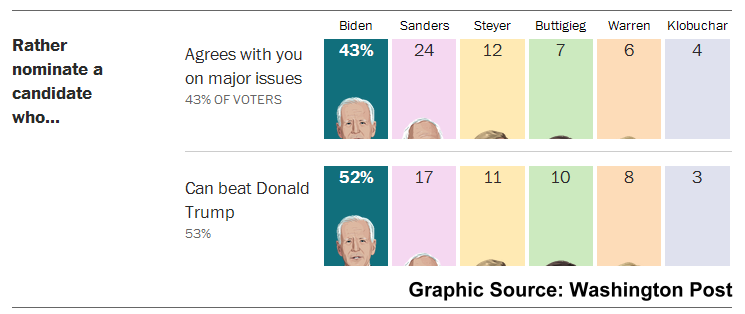
The endless polling to which Americans are subjected makes it very clear that most support the headline items in the progressive agenda advanced by Sanders, often by overwhelming margins,[2] but in a media environment that too often resembles some futuristic dystopian nightmare, these are the very items that are treated by the press as rendering Sanders unelectable. In the present cycle, the notion that Joe Biden is more "electable" than Sanders is treated as an article of faith in national news media. It's never interrogated, and it is, on a daily basis, relentlessly propagated on the major networks' news operations, by all the major newspapers and 24 hours a day on the cable news networks. This is done both directly and, more often, by implication, as Sanders is very aggressively presented as unelectable, someone who will lose and cost Democrats the congress. Perhaps recognizing the popularity of Sanders' issues, news media have, throughout the campaign, ubiquitously engaged in unethical push-polling--"polling" intended to drive public opinion in a particular direction rather than gauge it--by regularly commissioning polls in which respondents are asked  if they prefer a candidate who agrees with them on the issues or one who can beat Donald Trump, as if the two are self-evidently irreconcilable polar opposites. Such questions are also a demand by the free press and a significant faction of the political elite for a substance-free politics that should make every dogmatist of the liberal democracy shudder.[3]

A new CNN poll released on Monday is another to add to that particular pile. It asked respondents, "Which is more important to you personally, that the Democratic party nominate a presidential candidate with a strong chance of beating Donald Trump, or that the Democratic party nominate a presidential candidate who shares your positions on major issues?" An overwhelming 65% chose the candidate who can beat Trump vs. only 29% who chose a candidate who shares your positions.

This leads in to another question in the same poll, "Regardless of who you support, which Democratic candidate for president do you think has the best chance to beat Donald Trump in the 2020 presidential election?" An overwhelming 66% picked Joe Biden. vs. only 26% for Sanders. That's what 11 months of press propaganda on this subject has drilled into Democrats' heads.

But is it true? Here's the payoff, asked of a sample of registered voters:

These responses have a 3.5% margin of error. While a huge majority of Democrats have been convinced to think Biden obviously has the best chance of beating Trump, the poll shows that both Biden and Sanders are beating Trump and by exactly the same margin. Biden's greater "electability" appears to be nothing more than a press-generated phantom.

Worse, it's a phantom propped up by the refusal of the press to cover Biden's long and terrible record and, perhaps most damaging, his obvious cognitive decline.

From abortion to desegregation to trade to criminal justice issues to putting the screws to creditors on behalf of the financial services industry, Biden has, at some point in his career, been on the wrong side of nearly every major issue near and dear to the progressive base of the Democratic party. He is, for those seeking--or desperate for--policy substance, essentially a blank, someone who publicly disdains policy, who, historically, blows with the wind and who, in the present campaign, offers for policy only a string of thin, half-baked and generally very bad ideas slapped together by his underlings that he may say he has something and that are clearly as much a mystery to him as to everyone else. He is a half-wit, profoundly corrupt, a congenital liar whose big idea for ingratiating himself with black voters in South Carolina was to fabricate a personal history wherein he attended an historically black college (he never did), was involved with the civil rights movement (he wasn't) and claim he was arrested in the '70s while trying to see the then-imprisoned Nelson Mandela in Apartheid South Africa (he wasn't). He has, for both his own self-advancement and for the big checks given to him over the decades by his well-heeled donors, spent his entire career pushing government actions that harm wide swathes of his fellow Americans, from gleefully helping generate the mass-incarceration epidemic to helping create the student debt crisis to pimping Bush's Iraq war. At the moment, he's suffering what appears to be significant cognitive impairment. At his worst, he can barely form coherent words, can barely marshal the words he can manage into coherent sentences and doesn't even seem to know where he is. He can talk for extended periods without it being at all clear what he's trying to say or even what he's even talking about. He's thin-skinned and ill-tempered; in at least half a dozen incidents in the last few months, he's blown his top in conversations with voters, becoming instantly dismissive of their concerns, telling them to vote for someone else, even physically invading their space and putting hands on them. Earlier this week, he got into a confrontation with a Detroit auto-worker; while visiting the man's place of employment, Biden said he was "full of shit," a "horse's ass" and threatened to "go outside with your ass." Democratic voters haven't even been informed of most of this.[4] Neither has most of the wider public. Biden's record has plenty to turn off wide swathes of the Democratic coalition, while, in a general, he'd be taking on an incumbent president who has the fanatical support of his own base. His policy-free campaign that merely opposes most of the major items in the progressive agenda leaves him without anything Democrats can positively support. At the same time, he nullifies most of the big weapons Democrats could use against Trump; Joe Biden certainly isn't someone who can trash Trump as a compulsive liar, a dimwit, an authoritarian or a hundred other things policy-related and otherwise. His cognitive impairment could potentially convince millions of people who would ordinarily never consider voting for Trump that Trump was the safer, even more responsible choice. And if he becomes the Democratic nominee, it's safe to assume Trump and the Republicans will make sure all of it gets an extended airing.

For those who follow these matters, these claims of Biden's self-evident electability seem extremely questionable, at best, and utterly ludicrous in general.

There isn't a lot of polling about what the public has actually learned about the Democratic candidates but there are bleak hints. For example...

Bernie Sanders has made big structural changes a key issue in his campaign. Joe Biden has made returning to the "normalcy" of the Obama administration a cornerstone of his own, a sort of Make America Great Again for Democrats. In an incident in June, in fact, Joe Biden explained to a group of oligarchs at one of his endless big-money fundraisers that, under his administration, "nothing would fundamentally change." In a political environment in which people are screaming for major change, this was one of the 10,000 potentially campaign-ending things Biden has said or done but while it caused a furor on social media, it was--as usual--barely covered by the regular press and certainly not treated as a scandal. That CNN poll asked those same Democrats and Democratic leaners about this:

"Major changes" was backed by 69% of Democrats and 78% of Democratic-leaning independents.[5] It was supported by 90% of those who backed Sanders and 58% of those who backed Biden. And yes, these are the same voters who overwhelmingly say Biden is more electable and more numerously support him.

It gets better.

Questions like this have been included in some of the exit-polls from the already-concluded state contests. South Carolina turned around the race for Biden. Pollsters asked South Carolina Democrats who participated in their primary, "Do you think the economic system in the United States works well enough as is, needs minor changes or needs a complete overhaul?" Even in uber-conservative South Carolina, the bulk of voters--53%--told pollsters they thought the economic system needs a complete overhaul but this is how they voted:


Among an informed electorate, Biden's "nothing would fundamentally change" would loom large over this question--only 8% of South Carolina voters agree with it--but Biden gets the bulk of the majority of voters who say it needs a complete overhaul--over twice as many of those votes as Sanders. That group alone represents nearly 26% of the total SC electorate; if it had gone to Sanders instead of Biden, Sanders would have won the state.

It is, of course, possible that voters who wanted fundamental change simply chose not to prioritize this when voting but given the strength of the view itself--"needs a complete overhaul"--that seems remarkably counterintuitive.

The exit-polling in this campaign season has been rather poor; most of it is just basic stuff, with very few questions about actual issues, but all of them have asked about healthcare and one often finds those same bleak hints there.

Bernie Sanders has made Medicare For All one of his trademark issues. His support for it spans decades. His advocacy of it during the 2016 Democratic primaries convinced congressional Democrats--always far more conservative than the Democratic base--that it was a winning issue.[5] Of the other Democratic presidential contenders, only Elizabeth Warren, who has now left the race, supports Medicare For All, though even she backed away from the proposal months ago. Joe Biden has offered the strongest opposition to the policy; echoing the anti-M4A rhetoric of Donald Trump, he's spent most of the present campaign trying to undermine the strong Democratic support for it.[6]

Despite the combined efforts of Biden, most of the other Democratic presidential candidates, the insurance industry and Trump, Democrats, when polled properly, overwhelming back M4A. The standard exit-poll question on the matter has been, "How do you feel about replacing all private health insurance with a single government plan for everyone?" That's not an example of a proper poll on the issue. It adopts the conservative framing of M4A as taking away, rather than extending, coverage, misrepresents the policy (M4A eliminates duplicative insurance coverage, not all private health insurance) and doesn't include any of its benefits--the fact that it's cheaper, that it will allow people to keep their physicians, etc. It isn't the worst way to ask the question--the worst is to use this same framing plus present M4A as merely an expense, something that will raise taxes--but it is an effort by the pollsters to drive down the indicated support for it.[7]

What's surprising is that, even with this very bad framing, M4A has had majority or plurality support among Democrats in every state that has so far voted and in which exit-polls have been conducted.

To return to South Carolina, 49% of Democratic voters in even this deep-red conservative state supported it vs. only 46% opposed. But here's how they voted:

Head hurting yet? A whopping 62% of Medicare For All supporters voted for candidates who oppose Medicare For All. The bulk of these votes went to Joe Biden, the candidate who has been the most vehemently opposed to the policy. On the other side, 16% of those who opposed M4A voted for Sanders or Warren--a much lower figure but indicative of the same problem.

Follow this: Those who support M4A but voted for Biden are more than 25% of the total state electorate.

If they'd gone to Sanders instead of Biden, Sanders would have won.

Even if that faction--M4A supporters who voted for Biden--had split down the middle, with Sanders and Warren each taking half (and Warren wouldn't have gotten that much, given her proportion of the vote), Sanders would have won.

Even if, under either of these scenarios, one deducts from Sanders the voters who oppose M4A but still voted for him--5.5% of total voters--Sanders still wins.

Perhaps voters just didn't prioritize this, right? Well, when asked by the exit-pollsters which issue was most important to them, the plurality--41%--said "health care. The 2nd-most cited issue, income inequality, was chosen as most important by only half as many (and is, itself, another Sanders specialty on which Biden offers nothing but on which Biden gets the lion's share of the vote of those citing it). Maybe those who said healthcare was their most important issue were the ones who opposed M4A. Given the uphill fight that awaits any effort to pass M4A and its popularity among Democrats, that doesn't seem very likely. Maybe this is just a manifestation of the same low-information voters who have always been a critical part of Biden's coalition.

Evidence for a heavy presence of the latter is also found in a poll question regarding when voters decided on the candidate for whom they intended to cast their votes. Results:


The campaign had, by this time, been ongoing for over a year. Only deciding which candidate to support a few days before the primary suggests an extreme detachment from public affairs. The South Carolina results were also driven by a massive turnout of older voters, 71% over the age of 45. These are the contingents most susceptible to things like the three-week legacy-media gang-rape of Sanders leading into South Carolina, when Sanders led the race and the efforts by the press to obliterate him were at their height.[8] After his South Carolina win, by contrast, Biden was treated to a 3-day Triumph by the press; he became the conquering hero, regaled in those 3 days with over $100 million in free positive press coverage, leading directly into--and to--his Super Tuesday wins and continuing right to the present. That dollar-figure would probably be in the hundreds of millions now, and that fawning coverage has meant late-deciders are both plentiful and disproportionately breaking for Biden.

But before we entirely leave South Carolina, it should be noted that voters there were also asked one of those obnoxious push-poll questions that voters have been asked throughout the campaign season. "Would you rather nominate a candidate who agrees with you on major issues or can beat Donald Trump?" Results:


What I've cited here are trends across the many states that have voted and for which there is exit-polling data.

In Maine, a state Biden won by 1.1%, wholly 47% of voters were late deciders, the vast bulk of them going to Biden; 69% supported M4A but 24% of that--16.6% of the total state vote--went to Biden. In Massachusetts, 11.5% of total voters supported M4A yet voted for Biden; Biden won the state by a hair under 7%. M4A had the support of 62% of Minnesota Democrats but 16.2% of total voters supported it but cast their ballots for Biden; he won there by a little over 8%. In Tennessee, 53% supported M4A; 17% of the state's voters supported M4A but voted for Biden; 17.04% were late-deciders who voted for Biden; Biden won by just under 17%. In Michigan, just under 21% supported M4A but voted for Biden; 18.5% thought the economic system needed a complete overhaul but voted for Biden; Biden won the state by 16%. In Texas, 53% said they'd only decided for whom to vote in the past month and the largest chunk of those went to Biden; 63% said they supported M4A but just under a quarter of those--15% of total voters--voted Biden; Biden won the state by 4.5% of the vote. Turnout by older voters and particularly the elderly up everywhere. And so on. This has been the case across the Democratic contests, wherein healthcare has been cited as the top issue. Nearly all of the push-poll questions have found majorities favoring defeating Trump over a candidate with whose policies they agree.[see Update below]

At present, phantoms are conducting the train. They can do so in primaries, wherein attendance is a fraction of a general, but should Biden become the nominee, they won't be able to continue into that general. Biden's wins are being artificially driven by fawning and entirely uncritical press coverage that posits a narrative of him as the only hope against Trump, buries his record, conceals his flaws and attacks his opponent at every turn but this is a mask behind which is building to the potential coronation of a candidate who is more flawed than even Hillary Clinton, is contemptuous of the core animating issues of the activist Democratic base,[9] who offers no one any real, affirmative reason to support him. He's the Not Trump. And that's all. Fun fact: Sanders has already defeated Biden among independents in 16 of the 20 contests to date. The public will learn these things. How they'll be received, after it's too late to do anything about it, remains to be seen but their generating any real optimism for Biden seems the least likely scenario.[10]

There are other related matters I'd like to cover here--it seems a fairly obvious shortcoming that I haven't addressed how the Biden campaign is essentially a war by the elderly against their own children and grandchildren--but I'll put them aside for now.[11]

Where does all of this point? At a time when people are angry, frustrated, desperate for change, Democrats are being lulled by their party elites and the press into a politics almost entirely divorced from substance, one not only entirely incapable of confronting the problems that face so much of the population but entirely uninterested in doing so, one that is unworthy of winning, one that will, if allowed to succeed, almost certainly reelect Trump and make things much, much worse and one that has already said it won't make things any better even in the unlikely event that it does win the presidency.[12] We're already living through an effort to run the most powerful government on the planet through ignorance and fantasy. That isn't an approach an alleged opposition party should emulate.

--j.

---

 [1] A privately-commission poll conducted immediately prior to election day showed Sanders beating Trump by double digits.

 [2] The link there is to an article compiled in January 2016. It is, admittedly, hopelessly out-of-date but Americans have only gotten more progressive in the meantime.

 [3] It should be noted that neither that free press nor, most especially, that political elite believe in that substance-free politics. They offer it to the rank-and-file that they might continue to operate behind it in pursuit of their own agendas.

 [4] The confrontation with the auto-worker got some play but Biden was as celebrated for it as criticized. Something like that would have ended nearly any other campaign.

 [5] In 2015, Michigan Rep. John Conyers' Expanded & Improved Medicare For All Act managed to draw 49 co-sponsors in the House of Representatives. Its post-2016 successor, the Medicare For All Act--the House version of Sanders' current bill--now has 118 co-sponsors--a majority of the House Democratic caucus. Sanders' current Senate version has 14 co-sponsors out of the 45 Democrats in the body. The number of Senate supporters for his previous 2013 plan: 1. Sanders himself.

 [6] From "Give Me A Break: The Sad, Sorry Spectacle of Joe Biden," from 11 August, 2019:

[O]ne of the top Democratic priorities at the moment is creating a Medicare For All single-payer healthcare system, a policy Biden vehemently opposes. A few weeks ago, Biden launched a crusade of lies intended to discredit and defeat M4A, employing many of the same "arguments" against it being advanced by Donald Trump. At an AARP forum in Iowa, Biden said that under M4A, "Medicare goes away as you know it. All the Medicare you have is gone." This is, of course, entirely false--M4A, as the name implies, just significantly expands the existing Medicare program--but it also mirrors what Trump wrote in an op-ed back in October devoted, in part, to attacking the policy. According to Trump, "so-called Medicare for All would really be Medicare for None. Under the Democrats' plan, today's Medicare would be forced to die." Biden has repeatedly employed Trump's Orwellian characterization of M4A as taking away health coverage, rather than expanding it. "[T]he Democrats would eliminate every American's private and employer-based health plan," wrote Trump. Biden:
"How many of you like your employer based healthcare? Do you think it was adequate? Now if I come along and say you’re finished, you can’t have it anymore, well that’s what Medicare for All does. You cannot have it. Period."
Trump appeals to the absolute worst, most selfish "got-mine" entitlement psychology. "[Medicare For All] means that after a life of hard work and sacrifice," he wrote, "seniors would no longer be able to depend on the benefits they were promised." Biden incorporates all of this--without attribution, of course--into his own recent anti-Medicare For All ad.

 [7] Something probably worth keeping in mind when reading this. Democratic support for M4A is a lot stronger than even the exit-polling suggests.

 [8] I described this press environment in an article last week:
"While Sanders was winning contests, his lack of 'electability' and the idea that he would cost Democrats the congress were presented, hour after hour across national media outlets, as givens. Major media figures felt entirely comfortable repeatedly comparing the Jewish candidate to the rise of Nazism. Then, with no sense of self-awareness, they also compared him to plagues, disasters, etc. A major theme was to portray Sanders as an apologist for Marxist dictatorships, particularly the former Castro regime in Cuba. It was suggested that if Sanders the socialist won, there may be executions of dissidents in New York's Central Park. And so on. This endless campaign of defamation was the dominant news media narrative for three weeks..."
 [9] Biden recently submitted to a rare interview with Lawrence O'Donnell on MSNBC and was asked a hypothetical question; if he was elected and Bernie Sanders managed to pass Medicare For All through congress, would he sign it into law? Passing M4A would be, in the words of Walker Bragman, "one of the greatest legislative accomplishments in American history," but even during a growing coronavirus pandemic, wherein the U.S. is severely disadvantaged because of its lack of a M4A system--and even after even a conservative framing of M4A has drawn majority or plurality support among Democratic voters in every primary state that has so far happened--Biden suggested he would veto it. Much of the press barely mentioned this.

[10] Democratic elites aren't saying it but they seem to be depending on a recession, for which the U.S. is due, to finish off Trump, thinking that when the economy goes South, the public will support whoever they nominate. It's not an entirely unwarranted notion either--election-year economic downturns have a habit of washing away incumbent regimes--but this cynical gambit would seem a dangerous gamble for those most vulnerable to Trump's rule, particularly given the demoralization of the activist base that will follow if their will is--again--thwarted by the shady means presently being used to foist Biden on them. The Clintonite right that runs the official organs of the party correctly sees a Trump reelection as much less of a risk to themselves than the election of a progressive, which would mean the end of their own gravy-train.

[11] ...except for perhaps this footnote. Biden's support is mostly over 50 and heavily concentrated in the elderly, while, for the second presidential primary contest in a row, Sanders has the under-50s and is utterly dominant among the under-30s, groups to which Biden is utterly off-putting. Look at the age-split from Michigan:

The youth vote is an incredibly important constituency for the Democratic party--literally the future--but Democrats seem to have gotten it in their heads that they can win without it, which not only proves to be untrue (see 2016) but, given the illicit means by which the youth vote has been thwarted once and is on the verge of being thwarted again, can't help but lead to alienation and disinterest among young voters.

To tie those Michigan numbers into the commentary in the rest of this article, here are the Michigan general-election numbers going into that primary:


In the Michigan exit-polling, 57% of Democratic voters said they prefer a candidate who can defeat Donald Trump, but in the general election, Sanders beats Trump in the state while Biden only manages a tie.

[12] And, indeed, a Biden success in November would have extremely negative long-term consequences. It would close the door on any hope for progressive solutions to anything for at least the next 8 years. If a Biden-led ticket didn't cost Democrats the congress this year, he would certainly do so by the 2022 midterms--parties in the White House always lose seats in the first midterm. He'd then insist on running for reelection in 2024 and Democrats would insist on renominating him. Whether he won or lost a reelection bid, there would be no progressive in the White House until at least 2028.

---

UPDATE (Fri., 20 March, 2020) - Even with the growing coronavirus pandemic, three states still held their primaries on 17 March--states where the responsible officials should probably be prosecuted. Joe Biden, whose support is concentrated in the elderly, who are particularly at risk from the virus, encouraged people to go to the polls! Biden tweeted: "If you are feeling healthy, not showing symptoms, and not at risk of being exposed to COVID-19: please vote on Tuesday." But, of course, one of the hallmarks of the coronavirus is that people can be asymptomatic for extended periods but still be contagious, and anyone taking part in large gatherings of people--like at voting precincts--are, by definition, at risk for contracting it.

President Biden, indeed.

The result, as could be expected, was chaos. More to the point for our purposes here, the exit-polls, with somewhat different questions, still showed the same disconnect as documented above.

ILLINOIS
--76% of voters said they favor "legalizing the recreational use of marijuana nationwide," but 55% of those voters went to Biden, who doesn't favor such an approach, vs. only 39% to Sanders, who does (Biden has rejected legalization, putting forth, instead, a weak decriminalization, and even on that, he's waffled with time). The 47% of voters who "strongly favor" legalization split 47%-47% between Sanders and Biden.

--The exit pollsters changed the wording of the Medicare For All question in this round of primaries, asking the still-imperfect but improved, "Do you favor or oppose changing the health care system so that all Americans get their health insurance from a single government plan instead of private health insurance?" A huge 70% of Illinois Dems favored M4A. Unfortunately, 52% of those voters went to anti-M4A Biden vs. only 42% for pro-M4A Sanders.

--Voters were asked, "Do you favor or oppose the government canceling student loan debt for most people?" 72% of voters favored doing so but 53% of them voted for Biden, who opposes this policy, vs. only 41% for Sanders, who not only supports it but is the one who proposed it.

--As what I suppose one could interpret, given such responses, as a bit of pollster humor, voters were asked about qualities they thought were important in a Democratic nominee. Asked if it was important if the nominee "has the best policy ideas," 96% said it was important but 57% of those went to Biden vs. only 36% to Sanders.

Yeah.

Asked how important it was that the candidate "can beat Donald Trump," 93% said that was important but 60% of those went to Biden vs. only 35% to Sanders.


FLORIDA
--Asked the marijuana question, 75% of respondents said they favored legalization but 60% of those votes went to Biden vs. only 26% for Sanders.

--On Medicare For All, 72% of voters supported the policy but 58% of those voted Biden vs. only 29% for Sanders.

--74% favored cancelling student loan debt and Biden got 60% of those voters, Sanders only 27%.

--And yes, 97% said it was important that the Dem nominee have the best policies, and 62% of those went to Biden vs. only 23% to Sanders.

--94% said it was important that the Dem nominee be able to beat Trump; Biden scooped up 63% of them to Sanders' 23%


ARIZONA
--78% of voters favored legalizing marijuana; 41% of them voted for Biden vs. 35% for Sanders.

--78% favored Medicare For All; Sanders and Biden split those voters 38% to 39%.

--76% favored cancelling student loan debt; of those, Biden got 39% and Sanders 38%.

--96% said it was important for the Dem nominee to have the best policy ideas; Biden got 42% of those voters to Sanders' 32%.

--96% said it was important that the Dem nominee can beat Trump; Biden got 44% of those voters vs. Sanders' 32%.

Sunday, February 16, 2020

Bernie Sanders, Guns & the NRA: The Facts

In a sense, this author is an odd choice to write an article about Bernie Sanders and the National Rifle Association. While finding the NRA itself a reactionary grotesquerie worthy only of scorn and contempt, I'm not in any way a supporter of gun-control legislation. My views are radical in general and, in this matter, don't really lend themselves well to the kind of discussions of gun rights vs. gun control one usually finds within the context of the liberal democracy. At the same time though, a recurring--indeed, routine--theme of my writings on public affairs in the last few years has been correcting misinformation about Sanders, so perhaps I'm not so odd a choice for this after all. What I’m going to do here is mostly just whip into article-shape a cache of notes I’ve compiled from researching the subject over the years.

In Clinton cult mythology, it's an article of faith that Vermont Sen. Bernie Sanders is subservient to the National Rifle Association; pro-NRA, in bed with the NRA, owned by the NRA, supports the legislative agenda of the NRA. It's a notion repeated, in a seeming infinity of variations, hundreds--perhaps thousands--of times a day, every day across social media, anywhere internet discussions of public affairs occur. In the 2016 Democratic primary race, Hillary Clinton, finding herself outflanked on the left by Sanders on every real issue, tried to use Sanders' past opposition to a handful of gun-control measures as a wedge against him. She began attacking him on guns at least as early as August 2015, attacks that continued throughout that year and never abated until the primary season was over. Clinton's attacks were sometimes incredibly savage; at perhaps the lowest point in her campaign, she mobilized a group of survivors and family members of victims of the horrific Sandy Hook massacre and used them as props to suggest Sanders was responsible for the massacre and owed the survivors an apology. Sanders had supported legislation that immunized legal gun-dealers from lawsuits over such shootings--shooting over which those dealers had absolutely no control. Clinton herself went on television to demagogue this "issue," raving that "one of my biggest contrasts with Sen. Sanders is that he would place gun manufacturers rights and immunity from liability against the parents of the children killed at Sandy Hook is just unimaginable!" The sincerity of Clinton's passion on this issue can be gauged by recalling that she ran as an anti-gun-control candidate in 2008 and attacked Barack Obama for his support of gun-control policies but this kind of rank demagoguery during that campaign--aided and abetted by a string of articles in the press that badly distort Sanders' record--established the myth of Sanders as some kind of toady for the gun lobby.

The facts tell a very different story.


SANDERS' RECORD

Sanders has, over the years, voted against a handful of gun-control measures. Decades ago, for example, he voted against the Brady Bill, arguing that its waiting-period for handgun purchases was, more properly speaking, a matter to be handled by states and localities.[1] That's one of the two examples most frequently cited by Sanders' detractors, who inevitably point out that Sanders voted against the bill "five times," as if opposition to a single bill at different stages of its development can be turned into opposition to five. There is, of course, a good reason for this; anyone trying to present Sanders as anti-gun-control has almost nothing in his record with which to work. The other example always cited is the one Clinton demagogued so badly, Sanders' 2005 vote for the Protection of Lawful Commerce in Arms Act (the PLCAA), the law that shielded gun manufacturers and dealers from liability lawsuits. Sanders explained:
“Now, the issues that you’re talking about is, if somebody has a gun and it falls into the hands of a murderer, and that murderer kills somebody with the gun, do you hold the gun manufacturer responsible? Not anymore than you would hold a hammer company responsible if somebody beat somebody over the head with a hammer. That is not what a lawsuit should be about."
While his louder critics have presented this vote as some kind of unconscionable thing, all the law actually did was reaffirm a well-established legal principle. As Adam Winkler of the UCLA School of Law told Vox, even before passage of the PLCAA, suits against gun manufacturers and dealers inevitably failed, since "the law generally doesn't hold people liable for other people's criminal behaviors." Vox notes that "none of the lawsuits leading up to the PLCAA's passage actually succeeded. Time and time again, courts dismissed the challenges, or juries rejected them... [L]itigation against gun makers and sellers consistently failed in court. In the book Suing the Gun Industry, Wendy Wagner of Texas Law wrote that 'gun litigation has been an utter failure'..."

Starting in 2015, Sanders has expressed his willingness to revisit the question of liability:
"If you were a gun shop owner in Vermont, and you sell somebody a gun, and that person flips out and then kills somebody, I don't think it's really fair to hold the [gun shop owner] responsible... On the other hand, where there is a problem is there is evidence that gun manufacturers do know that they're selling a whole lot of guns in an area that really should not be buying that many guns--that many of those guns are going to other areas, probably for criminal purposes. So can we take another look at that liability issue? Yes."
Sanders threw his support behind an effort to amend the law.
"He proposed an amendment that would protect small, 'non-negligent,' 'mom and pop' gun shops. 'I do want to make sure that this legislation does not negatively impact small gun stores in rural America that serve the hunting community,' said Sanders, who represents Vermont in the Senate."
Sanders' detractors use these few examples to make all kinds of extravagant claims--Paul Heintz, writing in Alternet in 2019, ludicrously asserted that "during his first two decades in Congress, Sanders supported much of the NRA’s legislative agenda"--but Sanders' actual record is very different. Beyond a handful of exceptions (that are cited into infinity), Sanders has always supported tougher gun-control measures. He has, with the kind of consistency that has endeared him to many of his supporters, backed a ban on "assault weapons" from his first unsuccessful campaign for the House in 1988. In what would be the first of many efforts, he supported the 1994 ban. He opposed the 1996 effort to repeal it. The PLCAA itself expanded a ban on armor-piercing ammunition and provided for child safety locks on guns. In 1993, Sanders voted against a measure that would have eliminated state-based waiting-periods for gun purchases. Sanders cosponsored legislation to ban the distribution of files enabling 3D printers to create guns. He has sponsored legislation to block domestic abusers from acquiring firearms. He cosponsored legislation to block suspected terrorists from being able to buy a gun and, in an earlier bill, from being issued a license to own a gun or explosives. In 2009 and 2013, he opposed an effort to make concealed carry permits binding across state lines. He co-sponsored the Extreme Risk Protection Order Act, which supported local "red flag" laws that denied firearms to those deemed a danger to themselves or others. In 2013, he supported legislation that required background checks for gun sales between unlicensed sellers at gun shows and on the internet. That same year, he voted for several amendments to expand background checks through Harry Reid's Safe Communities, Safe Schools Act. In 1998, he supported legislation to increase criminal penalties for crimes committed with guns.

The pro-Sanders site FeeltheBern.org offers a rundown of Sanders views and record on gun policy:
"Bernie has voted in favor of a nationwide ban on military-style assault weapons, a nationwide ban on high-capacity magazines of over ten rounds, and nationwide expanded background checks that address unsafe loopholes... 

"When a standard gunstock is replaced with a bump stock, a semiautomatic firearm can fire more quickly. The Route 91 Harvest Music Festival shooter used a bump stock. This tragic mass shooting resulted in fifty-eight deaths and hundreds of injuries. 

"Bernie supported the ban on bump stocks, noting that they 'provide an effective workaround to convert a legal weapon into an illegal one.' ... Federal law currently stipulates that only licensed firearms dealers are required to conduct background checks. Bernie supports closing the gun show loophole, which allows private sellers to sell firearms to private buyers without background checks... Bernie has voted in favor of expanded background checks for all commercial sales with an exemption for sales between 'family, friends, and neighbors.' Bernie has also voted in favor of a national instant background check system...

"Given that 23 percent of the perpetrators of mass shootings have been found to suffer from mental health issues, Bernie believes that expanding access to mental healthcare can address some of the root causes of gun-related violent crime... One of the ACA provisions he successfully got added dramatically increased support for community health centers, which provide affordable primary care and mental health counseling to the underserved. The law authorized $11 billion to improve and expand community health centers over a five-year period. Mental healthcare is as important, if not more important, than physical healthcare in order to save the lives of others and not just the lives of the individuals with mental health issues... Bernie’s Medicare For All plan includes mental health services."
The few times Sanders opposed gun-control measures are disingenuously cited--and cited and cited and cited--by his Clintonite critics as representative of his history on gun policy, but this is Sanders' actual record.


SANDERS "IN THE POCKET" OF THE NRA?

In 2017, a MarketWatch story, citing the Center for Responsive Politics' OpenSecrets, asserted that Sanders had, in that cycle, gotten over $11,000 from the gun-rights lobby. The article has been shared all over the internet for years now. When this article is published and circulated, I expect that story will be cited everywhere it goes to counter it. Zipping over to OpenSecrets, though, one finds a very different story. Here's the list of federal pols who received NRA money in 2016. It's 3 pages long and Sanders isn't on it. Here's the site's list of all senators who received money from all gun-rights orgs in the 2016 cycle. It's a relatively long list for one page but, again, Sanders hasn't gotten a penny. As the Las Vegas Sun reported in 2018, Sanders has never gotten any money from the NRA.


Looking at it even more broadly, Sanders has, in fact, never gotten any money from any gun-rights group. Here's OpenSecrets' list of donations to current senators over their entire careers. Again, Sanders ain't on it.

The NRA issues legislative ratings on congressmen up for reelection--just like in school, "A" ratings for those who support the org's legislative agenda, "F" ratings for those who don't. When skimming through Twitter or Facebook, it's routine to see Clintonites claim Sanders has an "A" rating. Here are his actual NRA ratings[2] for the whole of his tenure in the federal government:


The NRA isn't a fan of Bernie Sanders.[3]


BERNIE SANDERS & THE NRA: A BRIEF POLITICAL HISTORY

In 1988, Sanders made his first run for the U.S. House of Representatives and came out in support of a ban on "assault-weapons." It was a three-way race, Sanders running as an independent taking on Democrat Paul Poirier and Republican Peter Smith. The NRA endorsed Smith but both Smith and Poirier signed the NRA's pledge not to support further gun-control legislation. Sanders refused. In 2016, the Washington Post recorded what happened next:
"John McClaughry, founder of public policy think tank Ethan Allen Institute in Vermont who was an NRA member at the time, recalled the NRA sending postcards and setting up a phone bank urging voters to support Smith. McClaughry said NRA 'went all out at Peter Smith’s urging the last week of the campaign,' tipping the votes to Smith’s favor.

"'Bernie was clearly the outsider from the NRA and the hunting clubs' [perspective],' Poirier, now a Sanders supporter, told The Fact Checker. 'They said, "Don’t vote for him. Paul Smith is our candidate. Paul Poirier is acceptable." ... [Sanders] did have the NRA, through the different associations in Vermont, actively working to make sure that nobody voted for him. That's an accurate statement [by Sanders]. I don’t know why people are questioning that."
Sanders went on to lose the race by a slim 3.5% of the vote. Over the years, Sanders has often expressed the opinion that he may have lost that race because of his support for gun-control measures. There's probably no way to ever know though.

While in congress, Smith flip-flopped and came out in support of an "assault weapons" ban, which infuriated the NRA. In 1990, the org set out to unseat him. Sanders was again running for the seat and again supporting an "assault weapons" ban. The NRA didn't endorse him but it did firmly endorse removing Smith, which may have benefited Sanders to some extent. In 2015, Judy Shailor, who was Smith's 1990 campaign manager, recalled:
"'The gun groups would say to me, "We are going to put him in office for one term and teach Peter Smith a lesson. Then we’re going to vote [Sanders] out,"' Shailor said. 'I said, "You won’t get him out.". . . He's one of the best master politicians I’ve ever come across.'"
The NRA distributed a mailer to its 12,000 members in Vermont, saying Sanders was a more "honorable" choice than Smith, by way of saying Smith lacked honor:
"'We don’t like everything that Mr. Sanders has to say about firearms,' NRA lobbyist James Baker told the Rutland Herald in 1990. 'But he's been upfront about it.'"
This is reinforced in a 1990 letter written by NRA lobbyist Mary Kaaren Jolly, explaining what the NRA did as strictly negative, a revenge move against Smith. "...the NRA did not endorse Bernie Sanders, he was viewed as the lesser of two evils. And yes, a vote for Sanders would be a clear protest vote against Peter Smith... Bernie Sanders was not our choice. We had hoped that a better democratic candidate would have been available. Yet, all the Vermont sportsmen's groups opposed Peter Smith and wanted the NRA to oppose him too." Smith "bragged, both in Vermont and in the District of Columbia, that he was using his reelection campaign to teach the NRA a lesson." He "told you and he told us he would protect and defend our gun rights. But the instant he had a chance, he voted against our gun rights. On the other hand, Bernie Sanders was upfront with us."[4]

On election day, Sanders destroyed Smith in a 17-point blowout.

Sanders' Clintonite detractors often mischaracterize this race rather badly to craft a phantom of a Sanders/NRA tag-team but the NRA's point, made very plain at the time, was to punish Smith for his heresy, not to support Sanders. If this helped Sanders, it's only because he was incidentally Smith's major opponent. The occasional wild claim to the contrary notwithstanding, the effects of the NRA's actions on the race, if it had any real impact, appear to have been negligible. Sanders picked up almost exactly the same percentage of the vote--56%--that he and the Democrat Poirier had split in 1988--56.4% (the official Democratic candidate in 1990, Delores Sandoval, was a non-factor, drawing barely 3%). Sanders would go on to repeat that percentage in his 1992 reelection campaign (57.78%), in which the NRA backed his opponent. It would, in any event, be absurd to make a fuss about the fact that the NRA came out against a sitting Republican, thus maybe helping elect the fellow who became the most progressive politician in congress.

Initially, I could find no record of the NRA supporting Tim Philbin, Sanders' Republican opponent in 1992 but I've since found a tweet from last year from a Twitter user named Davis Tom that reproduced a scan of an article by Jack Hoffman from the 28 August, 1994 edition of the Rutland Daily Herald. Hoffman writes, "In 1992, [the NRA] supported Sanders Republican opponent Timothy Philbin."[5] In 1994, the NRA endorsed Republican John Carroll in his efforts to take down Sanders:
"Sanders, a socialist seeking a third term, faces his toughest reelection challenge yet from Republican John Carroll, a businessman and majority leader of the state Senate... Besides what he calls a 'very strong' opponent, Sanders has to fight off opposition from the National Rifle Association and sporting groups, which have targeted him because he voted for an assault weapons ban earlier this year. Four years ago, the NRA helped the former Burlington mayor unseat Rep. Peter Smith, a moderate Republican who voted for a similar ban. This year, the NRA's bumper stickers read 'Bye, Bye Bernie,' instead of 'Dump Peter Smith.'"
In his 1997 memoir "Outsider in the House," Sanders himself recounted:
"During the 1994 campaign the National Rifle Association (NRA) had played a very forceful role against me. They distributed widely a 'Bye, Bye, Bernie' bumper sticker, held press conferences and public meetings, placed radio ads, made phone calls--and it was effective. There is no question that we lost many working-class men in that election because we handled the gun issue badly."
 In 1996, Susan Sweetser was the NRA's choice, and the slogan was "Get B.S. Out Of Washington."[6] In 1998, it was Republican Mark Candon.

I could find no record of the NRA officially endorsing Sanders' 2000 opponent Karen Kerin--a longtime member of Gun Owners of Vermont--but it gave her an "A" rating and Sanders an "F." Ditto for Bill Meub in 2002, Greg Parke in 2004 and, when Sanders first ran for the Senate in 2008, Richard Tarrant.

In 2012, the NRA (and Gun Owners of America) endorsed Republican John MacGovern in his ultimately unsuccessful effort to unseat Sanders.

I could find no record of the NRA endorsing Sanders' 2018 opponent Lawrence Zupan.


The notion of Bernie Sanders as a servile toady of the gun-rights lobby is rather violently at odds with the facts. The reality is that Sanders has always been a supporter of tougher gun control measures (though not all proposed measures of that genre), has never been endorsed by the NRA, has never gotten a penny from the NRA or any other gun-rights group and, in fact, the NRA and other gun-rights groups have, throughout his time in congress, repeatedly tried to unseat Sanders. The leadership of the NRA has never shared the confusion of Sanders' Clintonite detractors on where he stands on these issues or where they stand on him.

--j.

---

[1] Gun control is always best understood as a city/country dispute, not, as some try to understand it, a liberal/conservative one, and Sanders has always stressed that rural areas, where people grow up with guns, have a different culture than urbanized ones.

[2] The 1992-2012 ratings are as recorded by from Politifact, the 2018 rating courtesy of the Trace.

[3] At the other end of the spectrum, Sanders has enjoyed a 100% rating from the pro-gun control Brady Campaign to Prevent Gun Violence since at least 2013. If older ratings from the org exist, I've been unable to find them, which is why I'm putting this in a footnote instead of in the article proper.

[4] The letter:


[5] From the Rutland Herald, 28 Aug., 1994:


[6] That 1996 campaign, around which Sanders wrote "Outsider in the House," saw a major push by the Republicans and right-wing interest-groups to remove Sanders. In the book, Sanders recalls:
"Newt Gingrich and the House Republican leadership had 'targeted' this election, and spent a huge sum of money trying to defeat me. Some of the most powerful Republicans in the country came to Vermont to campaign for Sweetser, including Majority Leader Dick Armey, Republican national chairman Haley Barbour, presidential candidate Steve Forbes, House Budget chairman John Kasich, and Republican convention keynote speaker Susan Molinari. As chairman of the House Progressive Caucus, a democratic socialist, and a leading opponent of their 'Contract with America,' I've been a thorn in their side for some time. They wanted me out—badly.

"My campaign was also targeted by corporate America. A group of major corporations organized by the U.S. Chamber of Commerce, the National Association of Manufacturers, and the National Federation of Independent Businesses put me at the top of their 'hit list' and poured tens of thousands of dollars into the state to sponsor negative and dishonest TV ads, as well as a statewide mailing. By the end of the campaign Vermonters were watching four different TV ads attacking me.

"The wealthiest people in Vermont went deep into their pockets for my Republican opponent. They wrote out dozens of $1,000 checks (the legal maximum) and attended $500-a-plate functions. We also took on the National Rifle Association (NRA), the National Right to Work Organization, and other right-wing and big money organizations. Never before had the ruling class of Vermont and the nation paid quite so much attention to a congressional race in the small state of Vermont—a state with just one representative."
Update (Fri., 21 Feb., 2020) - The original version of this article had no information about the NRA's endorsement of Sanders 1992 opponent Tim Philbin. As that information has become available; the article has been updated to include it.]